The War on Immigration Has Come Home
LS
Introduction: The Flashpoint
The recent fatal shooting of Renee Nicole Good, a 37-year-old U.S. citizen and mother of three, by an Immigration and Customs Enforcement (ICE) agent in Minneapolis has become a national flashpoint, igniting protests from Texas to New York. The incident has cast a harsh spotlight on the aggressive tactics of an agency that is rapidly expanding its reach and power.
But beyond the daily headlines of street raids and violent confrontations, a deeper and more radical transformation of immigration enforcement is underway. This is not simply a story about immigration policy; it is a story about the changing nature of federal law enforcement in America, with far-reaching consequences that now touch the lives of citizens and non-citizens alike. The evidence points to an agency being reshaped into a national police force, blurring the lines between immigration control and domestic policing.
To understand what is truly happening, we must look past the political rhetoric and examine the facts on the ground. The following five points reveal the most impactful truths about this new reality, grounded in recent events, data, and a fundamental shift in strategy that is reshaping communities across the nation.
1. The Battlefield Has Moved From the Border to Your Backyard
The focus of the nation's immigration enforcement has fundamentally changed. Under the current Trump administration, the primary effort is no longer concentrated on the border but has pivoted to arresting and deporting undocumented immigrants from within the country's interior. This isn't merely a change in tactics; it represents a philosophical break from treating immigration as a border issue to redefining it as a matter of internal policing.
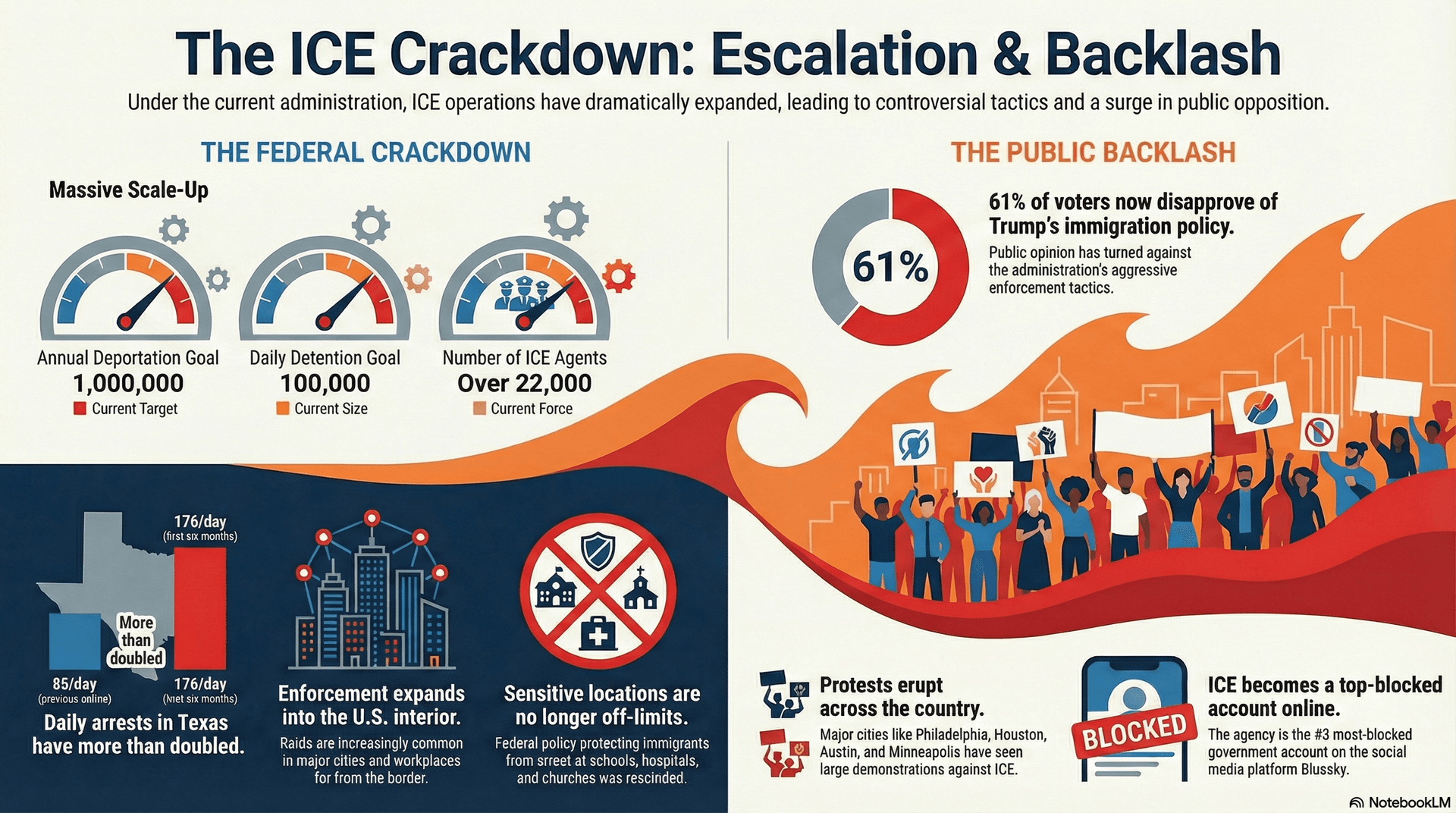
The data illustrates a dramatic escalation. In Texas, a state with an estimated 2 million undocumented immigrants, daily ICE arrests have more than doubled, jumping from an average of 85 per day during the final 18 months of the Biden administration to 176 per day under Trump. This intensification is visible in large-scale street raids in major urban centers like Houston and targeted operations on workplaces like construction sites. By moving the front lines of enforcement from remote stretches of the border to the very fabric of American community life, the administration has ensured the consequences of its policies are felt everywhere.
2. "Sanctuary" Spaces No Longer Exist
A long-held norm that provided a measure of safety in core community institutions has been officially dismantled. The Trump administration has formally rescinded federal policies that previously limited immigration arrests in "sensitive locations." This move deliberately collapses the civic spaces that once provided a firewall between enforcement and daily life, signaling that no aspect of community is immune from the agency's reach.
As a result, places that were once considered off-limits for enforcement actions are now potential sites for raids and arrests. This includes:
• Schools
• Churches
• Hospitals
The impact of this policy change is profound. Viral videos capture its human cost: a terrified mother trying to keep it together while her kids are crying as armed agents raid a family home. It instills a deep-seated fear within immigrant communities, forcing individuals to weigh the risk of deportation against the need to seek education for their children, receive critical healthcare, or find spiritual comfort. The elimination of these protected areas marks a significant break with past practice, another step in transforming ICE into a force that operates without the traditional restraints of domestic law enforcement.
3. A "Deportation Industrial Complex" Has Been Created with a Massive Slush Fund
The operational capacity of ICE has been expanded on an unprecedented scale, fueled by a gargantuan infusion of funding that has made it the highest-funded federal law enforcement agency in the country. A tax bill passed last year allocated $75 billion to ICE over the next four years, a sum critics have described as a "slush fund" with little to no meaningful oversight.
This funding is designed to create what the Brennan Center for Justice calls a new "deportation industrial complex." It enables a massive operational surge, including:
• Doubling the ICE agent force to over 22,000 agents.
• Establishing a new daily detention goal of 100,000 people.
• Setting a target of one million deportations per year.
This creates a self-perpetuating system where massive budgets and detention quotas incentivize enforcement actions, regardless of individual circumstances or even citizenship status, feeding a cycle of arrests and funding. This unprecedented funding and aggressive targeting is precisely what creates an environment where American citizens like Renee Nicole Good are caught in the dragnet. As New York City Mayor Zohran Mamdani stated, the result is an agency acting far beyond its mandate:
"We're seeing a government agency that is supposed to be enforcing some sort of immigration law, but instead, what it is doing is terrorizing people no matter their immigration status, no matter the facts of the law, and no matter the facts of the case."
4. American Citizens Are Being Caught in the Dragnet
The consequences of this hyper-aggressive enforcement are no longer confined to undocumented immigrants. American citizens are increasingly being harassed, detained, and, in the most tragic cases, killed.
The most prominent example is the death of Renee Nicole Good, a 37-year-old U.S. citizen and mother who, reports indicate, was serving as a legal observer when she was shot and killed by an ICE agent in Minneapolis. While the administration immediately labeled her a "domestic terrorist," many Americans who watched video footage from the agent himself conclude that the footage tells a different story. Her case is not an isolated incident. Since January 2025, over 170 U.S. citizens have been wrongfully detained. In Minnesota, the situation has become so pervasive that local police officials report their own off-duty officers of color are being stopped without cause and forced to produce paperwork. The chilling reality is that citizenship is no longer a guaranteed shield from being targeted by a federal agency operating with the power and impunity of a national police force.
5. Public Opinion is Sharply Turning Against ICE's Tactics
Despite the administration's goals, the aggressive expansion of ICE's power appears to be backfiring with the American public. A wave of outrage has resulted in protests erupting in hundreds of cities in both red and blue states, from Los Angeles to Philadelphia. The backlash has prompted lawsuits from the states of Minnesota and Illinois, as well as the cities of Minneapolis and Chicago. Online, ICE has become one of the most-blocked accounts on the social media platform Bluesky.
This growing disillusionment is reflected in recent polling data, which shows a significant portion of the public rejecting the administration's methods:
• 61% of people believe ICE's tactics are "too tough" (CBS News/YouGov).
• 55% of voters support ending mass ICE raids (ACLU).
• 52% of people feel that ICE is making communities less safe (CBS News/YouGov).
This powerful counter-narrative, driven by firsthand accounts and viral videos of enforcement actions, indicates that as more Americans witness the reality of these policies in their own communities, they are increasingly unwilling to accept the human cost.
Conclusion: A Changed America
The radical changes to ICE are about more than just immigration policy. They represent the fundamental transformation of a federal agency into what experts now call a "national police force"—one that operates with an unprecedented budget, diminished oversight, and an expanding mandate that increasingly blurs the line between citizen and non-citizen.
The implications of this shift extend to the very nature of American democracy and civil liberties. As Liza Goitein of the Brennan Center for Justice warns, the normalization of such a force could fundamentally alter public life.
"So my concern is that we’re moving towards a status quo in which the cities of this country really feel like police states. And to me, a police state is a place where the presence of—whether it’s the federal military or law enforcement—is so heavy and the chill on people’s exercise of their rights is so acute that people are really kind of living in fear, and they’re changing the way they behave."
This transformation raises a critical question for every American: When law enforcement operates with such expansive power and impunity, where is the line between ensuring security and instilling fear?