
The Hidden Rules Shaping Immigration Enforcement
LS
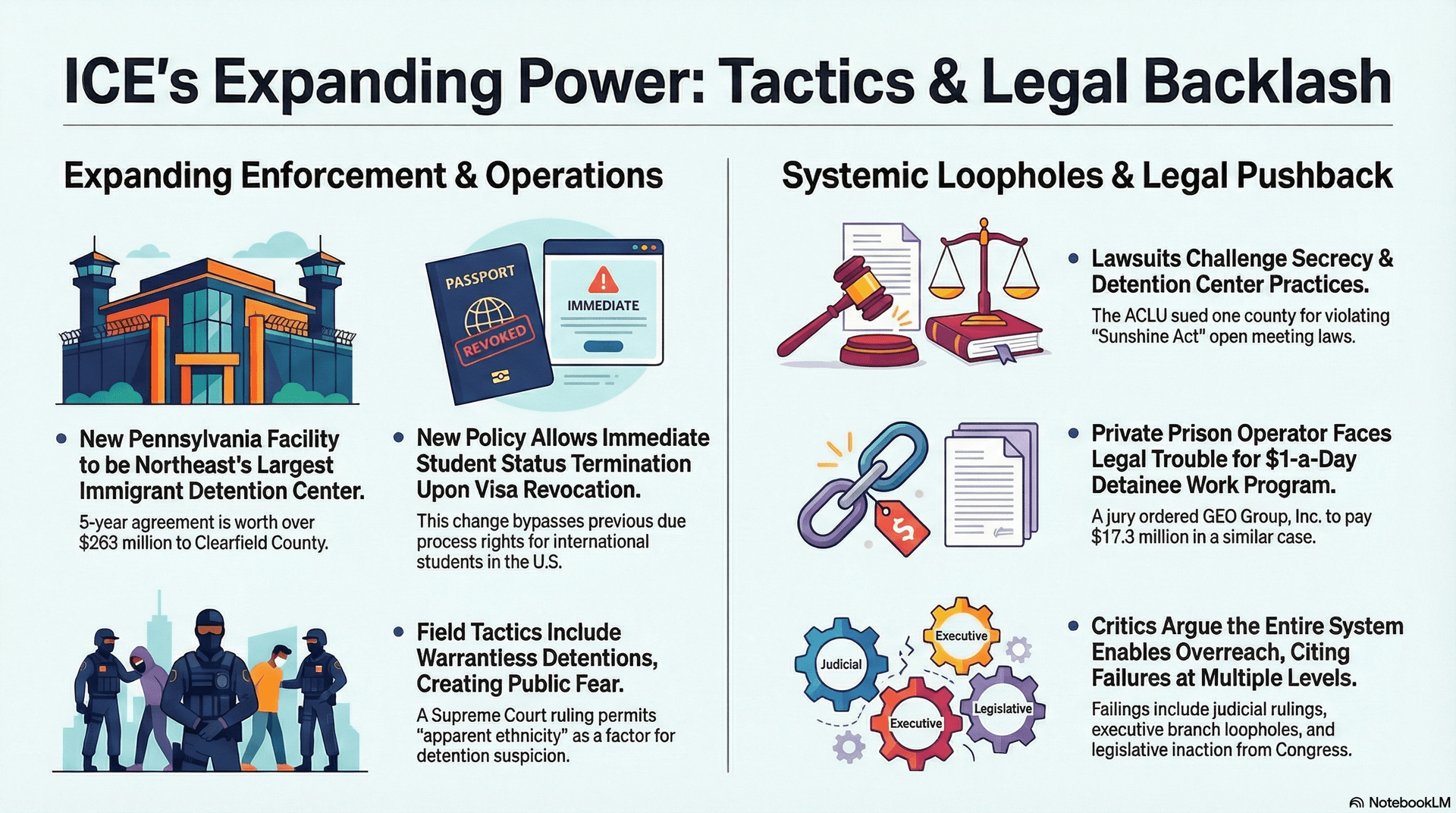
Immigration and Customs Enforcement (ICE) is a constant fixture in the news, yet the complex machinery of its daily operations often remains hidden from public view. Beyond the political debates, a system of court rulings, internal memos, and local agreements is fundamentally altering the agency's power. These seemingly disconnected events are not isolated incidents; they reveal a systemic shift of authority toward an executive agency that is operating with decreasing oversight from the courts, Congress, and the public.
This analysis illuminates the systemic realities of immigration enforcement. Drawing from recent legal challenges, investigative reporting, and internal government documents, it explores four of the most surprising and impactful facts about how ICE truly operates. Together, they demonstrate a troubling erosion of the traditional checks and balances designed to constrain executive power, creating new and startling realities for citizens and non-citizens alike.
"Apparent Ethnicity" Can Be a "Relevant Factor" for an Immigration Stop
In a controversial decision, the U.S. Supreme Court ruled that ICE officers can use "apparent ethnicity" as one of several factors to establish the "reasonable suspicion" needed to briefly detain an individual for questioning about their immigration status. The ruling came not from a fully argued case but from the court's 'interim docket,' often called the 'shadow docket,' which is reserved for emergency matters and typically involves abbreviated legal reasoning. This gives legal cover to a practice that critics argue amounts to racial profiling.
In explaining the majority's reasoning, Justice Brett Kavanaugh wrote that:
"apparent ethnicity" could count as a "relevant factor" when considered alongside factors such as speaking Spanish and gathering in certain locations to find work in specific jobs.
This standard was met with a fierce rebuke from within the court itself. Justice Sonia Sotomayor, joined by Justices Elena Kagan and Ketanji Brown Jackson, wrote a passionate dissent condemning the decision and highlighting the deep constitutional controversy that continues to surround the use of ethnicity in law enforcement stops. While the Supreme Court has broadened the legal justifications for a stop, another set of rules—or lack thereof—governs the conduct of agents during the stop itself, creating a separate layer of fear and ambiguity.
Masks and No-IDs are Permitted, Creating a Climate of Fear
A shocking loophole in federal law means that there appears to be no statute or regulation that requires ICE agents to show their faces or provide official identification when conducting stops and arrests. Agents are only required to state that they are government officers, a standard that has created a climate of fear and confusion.
This policy creates a harrowing scenario where armed individuals in an unmarked SUV can detain people in broad daylight, leaving the public and even other law enforcement agencies unable to distinguish between a legitimate federal operation and a criminal abduction. The danger is not hypothetical. The FBI has issued alerts warning that criminals impersonating ICE agents have committed serious crimes, including kidnappings and sexual assaults, by exploiting this very ambiguity.
For International Students, Legal Status Can Now Be Terminated Instantly
An internal ICE memo revealed a significant expansion of the agency's power over international students. According to the new guidance, a "U.S. Department of State Visa Revocation" is now sufficient grounds for the immediate termination of a foreign-born student's legal status in the United States.
This reverses longstanding policy that guaranteed students the right to a hearing or other forms of due process to challenge accusations before their legal status was revoked. The counter-intuitive nature of this change was highlighted by immigration attorney Steven Brown, who noted:
"[The new policy goes] against at least 15 years of SEVP guidance"
This is a stark example of how significant policy changes, affecting thousands, can be enacted through administrative fiat, bypassing the public debate and legislative scrutiny that would typically accompany such a fundamental shift in due process. This expansion of power through internal policy memos is mirrored at the local level, where secretive agreements create the physical infrastructure for detention with minimal public input.
The Largest Detention Center in the Northeast Was Approved Behind Closed Doors
In Clearfield County, Pennsylvania, county commissioners quietly approved contracts to open what will be the largest immigrant detention center in the Northeast United States. The agreement, valued at over $263 million for the county over five years, was met with immediate criticism from residents who said the decision was made behind closed doors.
The lack of transparency prompted the Pennsylvania ACLU to file a lawsuit, alleging that the commissioners violated the state's Sunshine Act, or Open Meetings Law, by failing to provide adequate public notice. Further controversy surrounds the private prison operator contracted to run the facility, the GEO Group, Inc. A federal jury recently ordered the company to pay nearly $17.3 million in back-pay to detainees at another facility for a work program that paid them just $1.00 a day. The proposed Clearfield facility includes the exact same work program. The inclusion of this exact work program in the new facility suggests that profitable but legally dubious practices are being replicated, often before previous legal challenges are even fully resolved, entrenching them in new long-term contracts.
A System of Failing Checks
Taken together, these four realities reveal a concerning pattern. From a Supreme Court ruling that permits the use of ethnicity in enforcement stops to an internal memo that summarily revokes legal status, the standard checks on executive power are being bypassed or are proving ineffective. At the local level, secretive deals made outside of public view are creating massive new infrastructures for detention with little to no community input.
The overarching theme is a systemic failure of oversight. When the courts appear to expand controversial powers and Congress fails to legislate clear limits, the mechanisms designed to ensure accountability are weakened. If traditional oversight mechanisms from the judiciary and legislature are failing, the impetus for reform falls directly on the public to make it an electoral priority.