5 Surprising Truths About the U.S. Immigration Crackdown
LS
Introduction: Beyond the Noise
The news cycle is saturated with images of immigration raids, tactical gear, and courthouse protests. It’s easy to feel overwhelmed, to tune out the noise of a story that seems to have no end. But peel back the curtain of political rhetoric, and a different story emerges—one fought not on the border, but in the fine print of legal memos and the defiance of federal judges.
This isn't another recap of the latest raid. This is a look beneath the surface at the surprising legal maneuvers, the damning data, and the sophisticated community responses often missed in mainstream reporting. We’re cutting through the political rhetoric to reveal five counter-intuitive and impactful truths about what’s really happening with the immigration crackdown in the United States.
1. It All Started With a Quiet Memo That Rewrote Decades of Law
The massive expansion of immigration arrests and detention didn’t begin with a presidential decree or a new act of Congress. It started with a quiet bureaucratic directive: the July 8 "Lyons Memo," a document that effectively upended decades of established immigration law.
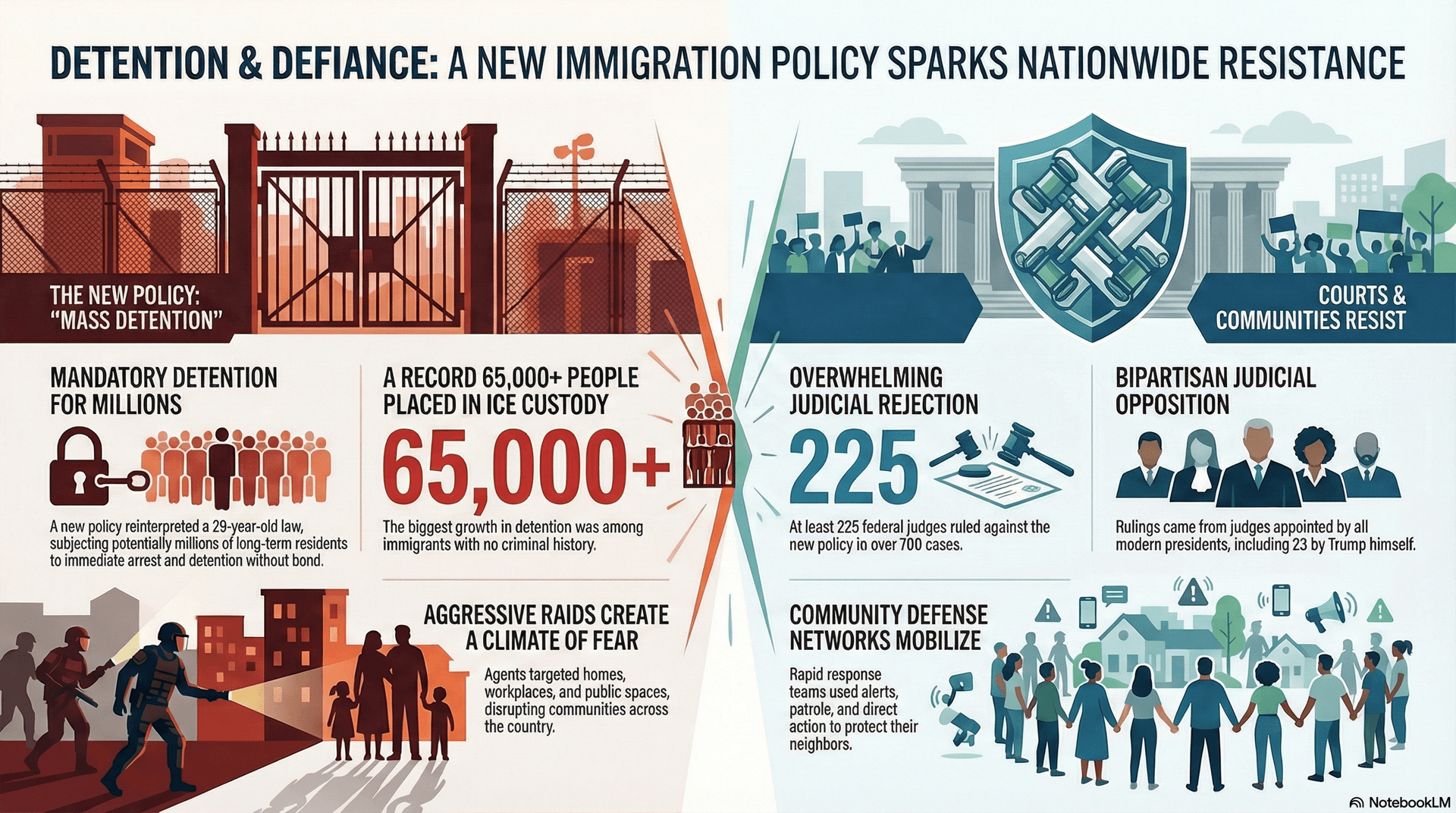
For years, the system operated under a clear distinction. Non-citizens already living inside the U.S. were typically subject to discretionary detention under section 236(a) of the Immigration and Nationality Act, meaning they were often eligible for a bond hearing and could be released while their case proceeded. The Lyons Memo changed everything by radically reinterpreting a 29-year-old statute, section 235(b). Suddenly, the government’s position was that virtually every non-citizen who had ever entered the country without lawful admission was now subject to "mandatory detention" with no right to a bond hearing—no matter how long they had lived in the U.S., raised families, or contributed to their communities. A federal district court highlighted the absurdity of this new legal interpretation with a simple analogy:
"someone who enters a movie theater without purchasing a ticket and then proceeds to sit through the first few minutes of a film would not ordinarily then be described as ‘seeking admission’ to the theater.”
This seemingly small administrative change had an enormous impact, exposing hundreds of thousands, if not millions, of people who had been living peacefully in the United States to the immediate threat of arrest and indefinite detention.
2. The Unseen Rebellion: Hundreds of Federal Judges Are Striking Down the Policy
While this bureaucratic maneuver was designed to operate in the shadows, it has been met with a resounding and public rebuke from the one branch of government positioned to challenge it: the federal judiciary. This isn’t a case of a few activist judges; it is a widespread, bipartisan judicial revolt.
According to a Politico report, at least 225 federal judges have ruled against the policy in over 700 cases. In stark contrast, only eight judges have sided with the administration. This wave of opposition is ideologically diverse, coming from judges appointed by every modern president, including 23 appointed by Trump himself.
These are not simple procedural rulings. Judges are writing "thorough, persuasive opinions" explaining why the new policy is unlawful. In one particularly strident decision, Judge Lewis Kaplan of the Southern District of New York captured the legal and moral weight of the judicial response:
"Requiring the detention of noncitizens like [the petitioner in that case] would be inconsistent with how immigration law in this country long has worked, not to mention the rule of law and basic notions of due process."
This trend is a critical, underreported story about the judiciary’s role in holding the executive branch accountable to the law, representing one of the most significant legal pushbacks against the administration’s policies to date.
3. The "Violent Criminal" Narrative Collapses Under Scrutiny
Even as the administration's legal authority crumbles in court, its public justification for the crackdown—the targeting of violent criminals—collapses under the weight of its own data. The data paints an undeniable picture. Far from a targeted operation against dangerous felons, the crackdown overwhelmingly sweeps up the non-violent. According to HIAS, over 70% of immigrants in ICE custody have no criminal record at all, and a staggering 93% have never been convicted of a violent crime. Data analyst Austin Kocher confirms this trend, noting that the largest growth in ICE detention is among those with no criminal history. This pattern was laid bare during a Chicago enforcement blitz where, by the government's own risk metrics, 78% of those arrested were classified as "low risk." Similarly, a high-profile raid on two California cannabis farms that netted 361 migrants yielded only four individuals with "extensive" criminal records. The gap between rhetoric and reality isn't a crack; it's a canyon.
4. Stop-and-Frisk Didn't Disappear—It Found a Federal Badge
The administration's legal end-run isn't just confined to rewriting statutes; it's also reviving unconstitutional policing tactics on the streets of America's largest cities. In places like New York, ICE is effectively reviving the tactics of the NYPD's controversial "stop-and-frisk" era, but with a crucial difference: a lack of oversight.
During a recent raid on Canal Street in Manhattan, agents officially tasked with targeting "counterfeit goods" were witnessed stopping people based on their appearance, accent, and perceived nationality to demand identification. This is precisely the kind of racial profiling that led a federal judge to rule the NYPD's practices unconstitutional in the landmark 2013 case, Floyd v. City of New York.
The problem lies in an accountability gap. The Independent Monitor established to oversee NYPD reforms has no jurisdiction over federal agencies like ICE. This means federal agents can conduct street-level stops without any requirements for data collection, public reporting, or independent oversight. As one analysis bluntly put it:
“Stop-and-frisk didn’t die; it found a federal badge.”
This revival of a discriminatory policing tactic through a "federal door" creates an end-run around constitutional reforms, leaving communities vulnerable to profiling without the checks and balances designed to protect their civil liberties.
5. The Grassroots Shield: Communities Mobilize Sophisticated Defense Networks
But as federal power asserts itself on city streets, a different kind of power is rising to meet it: sophisticated, organized community defense. The response to the raids has gone far beyond traditional protests, particularly in cities like Chicago, where a complex ecosystem of resistance has emerged.
This grassroots movement employs a range of organized tactics, including rapid response networks and hotlines to instantly verify ICE activity, Migra Watch patrols that document raids and inform residents of their rights, and community alerts like the use of whistles to warn neighbors when agents are present. It also includes powerful mutual aid efforts, such as delivering food and groceries to families who are in hiding and afraid to go outside. This is a broad-based movement where people from all backgrounds are "running toward danger, together" to provide a shield for their communities. Organizer Jocelyn Walsh captured the spirit of the resistance:
“The best way to respond to fear and intimidation tactics is to show we’re not afraid. We’re going to keep showing up. We’re going to keep speaking out.”
Conclusion: A Fight for the Soul of the Law
The current immigration crackdown is not a simple story of law and order. It is a complex battle being waged in courtrooms, debated in public discourse, and fought on city streets. The conflict has revealed surprising tensions: between an executive branch seeking to expand its power and a judiciary pushing back; between official government narratives and the stubborn facts on the ground; and between federal authority and the powerful resilience of local communities.
As these legal and street-level battles continue, the quiet re-writing of laws and the loud defense of neighbors raise a fundamental question: What kind of country are we choosing to be, one memo and one community at a time?