
5 Shocking Truths About Modern ICE OperationsNew Post
LS
Introduction: Cutting Through the Noise
U.S. Immigration and Customs Enforcement (ICE) is one of the most polarizing and misunderstood government agencies in America. Between sensationalized headlines and fiery political rhetoric, it can be nearly impossible to grasp how the agency actually functions.
However, beyond the noise, a very different picture emerges from government documents, internal training manuals, watchdog reports, and investigative journalism. This article cuts through the rhetoric to reveal five of the most surprising and impactful facts about how ICE actually operates today, grounded in verifiable sources.
1. That "Police" Officer at Your Door Might Be ICE
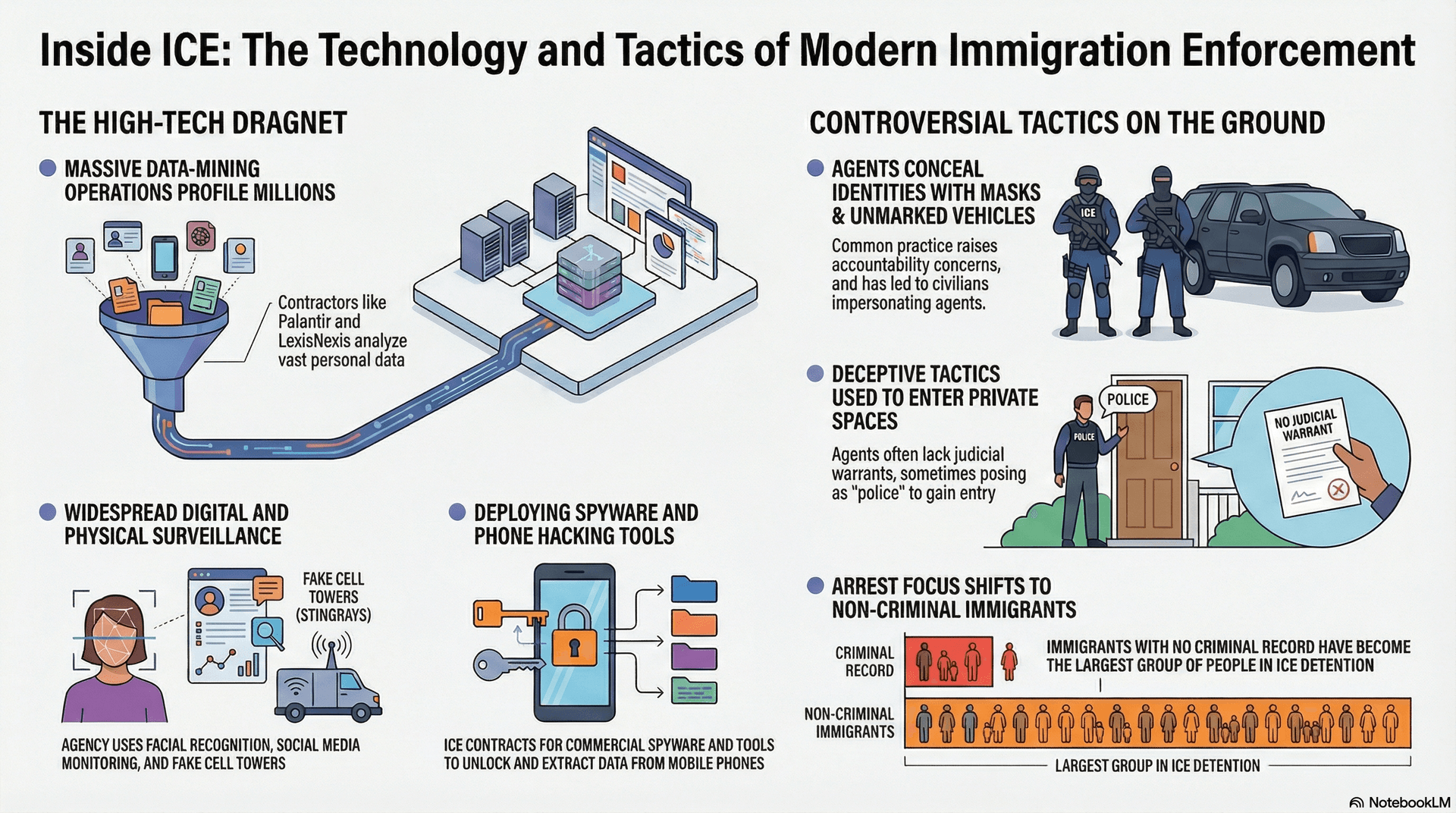
One of the most common and officially encouraged tactics used by ICE agents is identifying themselves simply as "police" to gain entry into private homes and businesses, especially when they lack the legal authority to force their way in. This practice is not random; it is a calculated and systemic methodology written into the agency's own training manuals.
The key to understanding this tactic is the difference between two types of warrants:
• Judicial Warrant: This is a warrant signed by a judge. It grants law enforcement the authority to enter the private areas of a home or business specified in the warrant.
• Administrative Warrant: This document (often a Form I-200 or I-205) is issued internally by the Department of Homeland Security. It does not grant agents the authority to enter a private residence or non-public area of a business without consent.
Because agents often operate with only administrative warrants, which provide no legal power of entry, they rely on obtaining consent. The "police" ruse is critical to this strategy, leveraging the public’s trust in local law enforcement to get people to open their doors. In 2020, a lawsuit challenging this "knock and talk" practice resulted in a federal court ruling against it, yet the tactic persists as an institutionalized technique. This misrepresentation has a corrosive effect, eroding the trust between immigrant communities and the local police departments they might otherwise turn to for help.
2. The "Worst of the Worst" Narrative Is Contradicted by Their Own Data
The Department of Homeland Security (DHS) consistently messages that ICE targets "the worst of the worst," focusing its resources on apprehending dangerous criminals like "child pedophiles, drug traffickers, and burglars." This narrative paints a picture of an agency laser-focused on public safety. This gap between public messaging and on-the-ground reality echoes the deception used at the doorstep.
The government's own data tells a different story.
As of September 2025, immigrants with no criminal record have become the single largest group in ICE detention. According to official figures, there are 16,523 detainees with no criminal history, compared to 15,725 who have a criminal record and 13,767 with pending charges.
This shift reveals a fundamental change in priorities, where meeting politically motivated arrest quotas has taken precedence over the publicly stated mission of targeting dangerous criminals. To hit these numbers, agents are encouraged to make "collateral arrests"—detaining any undocumented individuals they happen to encounter during an operation, even if those people were not the original targets and have no criminal history. The discrepancy between ICE's public messaging and its operational reality reveals an agency driven by metrics over its stated mission.
3. ICE Is a High-Tech Surveillance Agency Fueled by Your Data
While the public image of ICE often involves raids and boots-on-the-ground enforcement, a core and rapidly growing part of its mission is a vast, technologically advanced surveillance apparatus that draws on enormous reserves of public and private data.
• Data Brokers: ICE uses commercial data brokers like LexisNexis to access enormous databases of personal information. In one seven-month period, the agency performed over 1.2 million searches—a volume that far exceeds what would be necessary for checking only for "serious criminal backgrounds."
• Mass Surveillance Software: The agency uses Palantir's "Investigative Case Management" (ICM) system to aggregate data from numerous sources and build detailed, searchable profiles of immigrants. This software allows agents to filter people by immigration status, physical characteristics, and location data to streamline deportation operations.
• Cellphone Tracking: ICE deploys cell-site simulators, often known as "Stingrays," inside specialized vehicles. These devices mimic cell towers, tricking nearby phones into connecting to them and revealing their location. Watchdog reports have found that agents often use this technology without obtaining the proper judicial warrants.
• Social Media Monitoring: The agency has sought to hire contractors to monitor social media not just for direct threats, but also for "negative sentiment." This plan could flag constitutionally protected criticism of the agency, pulling law-abiding individuals into a threat-monitoring dragnet.
Taken together, these tools—from commercial data brokers to warrantless cell phone tracking—transform ICE from a traditional enforcement agency into a modern surveillance apparatus capable of building detailed digital dossiers on millions of people with minimal judicial oversight.
In an ironic act of counter-surveillance, artist and researcher Sam Lavigne turned these same data-scraping techniques back on the agency. He wrote a program that scraped the professional networking site LinkedIn to create and publish a database of 1,595 ICE employees. Explaining his rationale, Lavigne noted the subversive power of this reversal.
"I find it helpful to remember that as much as internet companies use data to spy on and exploit their users, we can at times reverse the story, and leverage those very same online platforms as a means to investigate or even undermine entrenched power structures."
4. Agents Wear Masks for a Reason—But It Creates a Dangerous Reality
In recent years, it has become common for ICE agents to conduct arrests while wearing masks, dressed in plainclothes, and using unmarked vehicles that sometimes lack license plates.
The official justification, according to ICE's acting director Todd Lyons, is to protect agents and their families from doxxing and a claimed "830 percent increase in assaults." While he is "not a proponent of the masks," he has stated he will allow them as a tool to keep his personnel safe.
However, this practice has dangerous consequences. It blurs the line between legitimate law enforcement and criminality, making it nearly impossible for the public to verify if the armed individuals they are encountering are truly federal agents. This has created a terrifying opportunity for criminals, and there are multiple documented cases of predators impersonating ICE agents to commit horrific crimes, including kidnapping and sexual assault. The lack of clear identification makes accountability nearly impossible and sows deep mistrust.
As Los Angeles Mayor Karen Bass stated in response to the practice:
"I don’t think you have a right to have a mask and snatch people off the street."
5. A Rush to Hire Has Allowed Unvetted Recruits to Enter Training
In the administration's push to hire 10,000 new officers by the end of the year, ICE's accelerated hiring process has been dangerously compromised, according to current and former Homeland Security officials who spoke to NBC News. This failure of internal standards directly compounds the accountability problems created by masked agents operating in the field.
The officials revealed that over 200 new recruits showed up for training before being fully vetted. It was only after their arrival that the agency determined they had "failed drug tests, had disqualifying criminal backgrounds, or had not met the physical or academic requirements to serve."
The vetting process, which historically took up to a year to complete, has been compressed to as little as two weeks. This rush to meet hiring goals has created a situation where individuals with criminal histories of their own are being placed into a powerful law enforcement training program. The public safety implications of putting unvetted individuals into roles with the authority to carry a weapon and detain people are profound.
Conclusion: A Question of Accountability
The reality of modern ICE operations is far more complex and troubling than public statements suggest. These five truths are not isolated incidents but symptoms of a consistent operational pattern. This pattern is defined by a reliance on deception to circumvent legal limits, a vast surveillance network that operates with little oversight, enforcement tactics that obscure identity and evade accountability, and a compromised hiring process that erodes internal standards.
These are the hallmarks of an agency whose rapid expansion in power, technology, and mission has dangerously outpaced its transparency and accountability mechanisms. As these practices continue, the fundamental question remains: In a democracy, who polices the police?