
4 Surprising Truths About ICE Enforcement in AmericaNew Post
LS
Introduction: Hook the Reader
The headlines are a constant source of anxiety for communities across America: workplace raids, surprise inspections, and aggressive enforcement actions by Immigration and Customs Enforcement (ICE). As policies have shifted towards more frequent and widespread operations, from agricultural fields to urban businesses, a climate of fear and confusion has taken hold. Many families and business owners feel powerless, uncertain of their rights in the face of federal agents.
While many articles cover the basics, they often miss the counter-intuitive and impactful realities of modern immigration enforcement. Understanding these less-obvious truths is not just an academic exercise; it is a critical component of protecting yourself, your business, and your community. The difference between knowing and not knowing your rights can determine whether a situation escalates or is managed with dignity and legal standing.
This guide delves into four surprising realities of ICE enforcement. It moves beyond the headlines to reveal the specific rules, tactics, and vulnerabilities that define these encounters. By understanding these truths, you can better prepare for and navigate the complexities of an enforcement environment that touches everyone, regardless of their immigration status.
--------------------------------------------------------------------------------
1. Your Front Door Is a Powerful Shield—If You Know the Rules
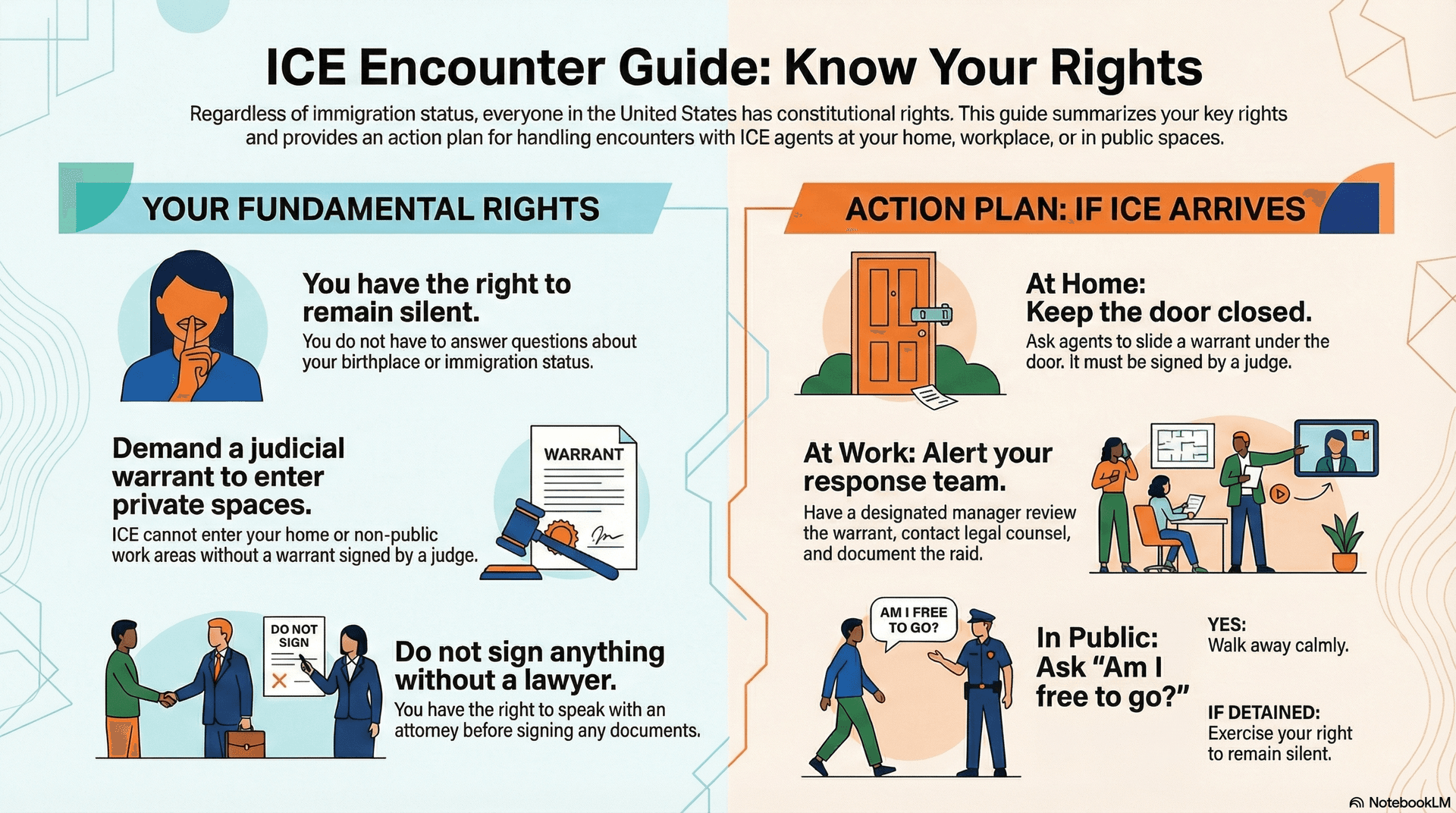
One of the most significant and dangerous misconceptions about immigration enforcement revolves around warrants. Many people believe that if an agent claiming to be law enforcement knocks, they must open the door. This is not true, and understanding the difference between two types of documents is your first and most powerful line of defense. The key is to distinguish between a judicial warrant, which is signed by a judge and grants legal authority to enter private areas, and an administrative warrant (often on Form I-200 or I-205), which is issued by ICE itself and does not grant this authority without your consent.
The practical, actionable advice is simple but crucial: do not open your door. Instead, ask the agents to slide the warrant under the door or hold it up to a window for inspection. Carefully verify that it is signed by a judge (not an ICE official) and that it lists the correct name and address. Be aware that agents are permitted to lie and may use a deceptive pretext to gain entry, such as pretending to be local police investigating a crime in your neighborhood. Your consent to let them in forfeits your most important constitutional protection against an unauthorized search. This distinction isn't a legal technicality; it is a fundamental check on executive power at the household level, reaffirming that your home is a constitutionally protected space.
"Immigration agents cannot enter private areas of your workplace without a valid judicial warrant or your consent. Administrative warrants (Form I-200 or I-205) do not grant this authority."
2. ICE's Intelligence Comes From Surprising—and Sometimes Personal—Places
It's a common assumption that ICE enforcement actions are the result of large-scale, impersonal investigations. The reality is often far more local and personal. In an interview with NPR, ICE Special Agent in Charge Rebecca González-Ramos revealed that her office acts on tips from the public. These tips are not always from concerned citizens; many are "revenge tips" from disgruntled neighbors, ex-spouses, or even business competitors seeking to gain an edge.
This reliance on personal grievances is compounded by an expansion of data sharing that blurs the lines between civil life and immigration enforcement. ICE has gained access to personal information from state Departments of Motor Vehicles, as it did in Puerto Rico, and from the federal government, which began sharing the personal information of nearly 79 million Medicaid enrollees with immigration authorities. This data sharing is so formalized that the agreement specifies ICE agents can only review the database during standard business hours, from 9 a.m. to 5 p.m., as if it were any other administrative task.
The implication is chilling: routine civic acts like getting a driver's license or applying for a family member's healthcare are now being weaponized as intelligence streams for deportation operations. This effectively turns our civil infrastructure into a tool of state surveillance, eroding the trust between individuals and the government agencies meant to serve them.
3. Legal Status Isn't a Bulletproof Vest
A pervasive and dangerous myth is that only undocumented individuals are at risk during an enforcement action. The facts show that even those with lawful immigration status, including green card holders, can be detained or targeted for deportation. These incidents highlight that an encounter with ICE can be a high-stakes event for any non-citizen.
The case of Mahmoud Khalil, a Columbia University student and green card holder arrested under an obscure 1950s-era law despite having no criminal charges, is a powerful example. And he is not alone. This tactic has been used against other students with lawful status, including Ranjani Srinivasan, Badar Khan Suri, and Yunseo Chung, indicating a broader willingness to target non-citizens regardless of their legal standing. This means that during a worksite raid or if stopped for questioning on the street as part of an operation, a green card holder who left their wallet at home can be detained and transported to a facility simply for verification. This policy creates a permanent state of vulnerability for all non-citizens, blurring the legal lines that are supposed to provide security and due process.
This reality underscores a critical point: it is essential for all non-citizens, including lawful permanent residents, to carry their valid immigration documents with them at all times.
4. You Have the Right to Remain Silent, But You Must Verbally Claim It
The right to remain silent is a fundamental constitutional protection that applies to everyone in the United States, regardless of their citizenship status. However, unlike what is often portrayed in movies, this right is not automatic. Simply staying quiet is not enough; you must explicitly and verbally state that you are exercising this right.
If you are stopped or questioned by an ICE agent, you must clearly state your intention. A simple but powerful phrase is all that is needed: "I wish to remain silent and would like to speak with a lawyer." Once you have invoked this right, you should not answer any further questions about your immigration status, where you were born, or how you entered the country. Crucially, while you are exercising your right to be silent, you must not run, physically resist, or obstruct the agents in any way, as this can lead to criminal charges. Actively claiming your Fifth Amendment right is not an act of defiance but a defense of a core constitutional principle that protects every person from self-incrimination.
"Anything you tell an agent or officer can be used against you in immigration proceedings."
--------------------------------------------------------------------------------
A Final Thought
The landscape of immigration enforcement is complex and often intimidating, governed by rules that are not always intuitive. The four truths outlined here reveal that the most effective tools for navigating this environment are not defiance or fear, but knowledge and preparation. Understanding the limits of an administrative warrant, the sources of ICE's intelligence, the risks faced even by legal residents, and the proper way to invoke your constitutional rights transforms a person from a passive target into an informed individual. This knowledge empowers you to protect not only yourself but also your family, your employees, and your community.
In an environment of increasing surveillance and enforcement, what is the role of the ordinary citizen in upholding the constitutional rights that protect everyone?